Model Y Standard vs Premium: what do you actually give up?
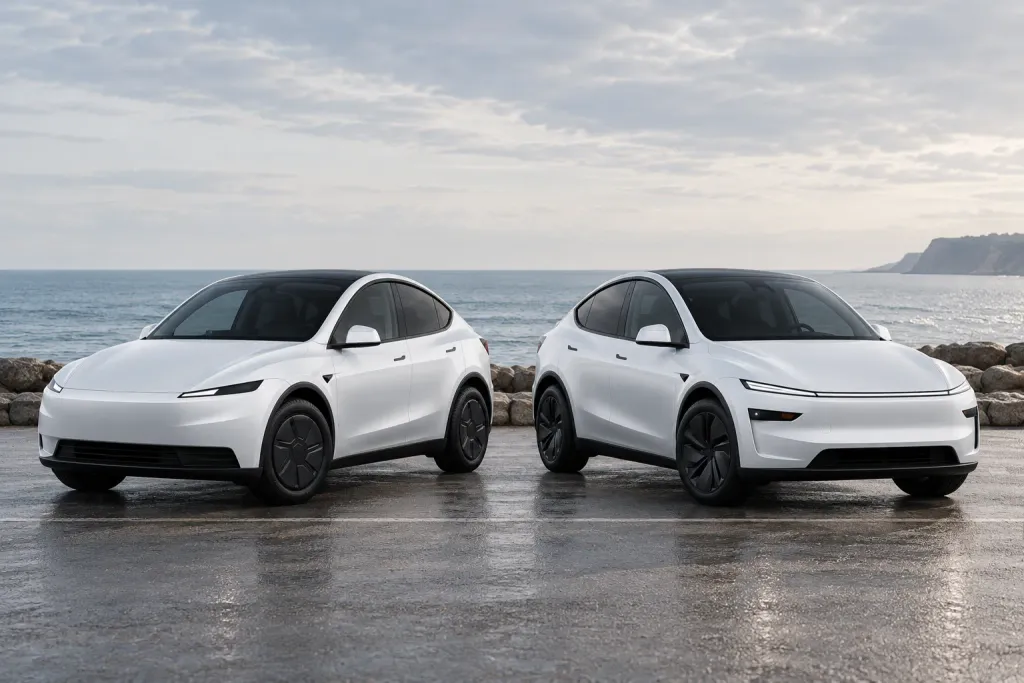
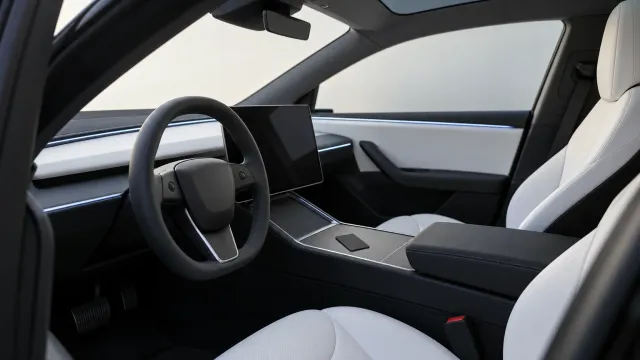
Tesla's own comparison shows the Standard keeping the core of the Model Y (five seats, the 16-inch screen, cargo space, towing, cameras and Full Self-Driving (Supervised) capability) and dropping comfort and finish items that the Premium has, such as the glass roof, ventilated seats, a rear screen and a 15-speaker audio system. It also lists less range, and less range added per 15 minutes of Supercharging.
Who this comparison is for
This is for the United States. Every difference below comes from the Compare Models view on Tesla’s Model Y design page, which we consulted on Oct 19, 2026, not from reviews or forums. Tesla can change what each version includes and the page shows prices that move, so we quote none: open it on the day you decide and check each row again.
Tesla’s view compares three versions: the Standard rear-wheel drive, the Standard all-wheel drive and the Premium rear-wheel drive. We use Tesla’s wording for each row.
What is the same
Tesla lists these as the same in all three: 8 exterior cameras, hands-free power open on approach, 2 wireless phone chargers, the Grok voice assistant, Chill and Standard drive modes, Full Self-Driving (Supervised) capability, traffic-aware cruise control, vehicle-to-load (120V, 20A AC), towing of 3,500 lbs, 76 cubic feet of cargo space and five seats. Tesla also lists a 16-inch front touchscreen in all three, QHD in the Premium.
So the Standard is not a smaller or lesser kind of Model Y. What you give up is in the tables below.
Range, speed and charging
| Standard RWD | Standard AWD | Premium RWD | |
|---|---|---|---|
| Range (EPA est.) | 321 mi | 294 mi | 355 mi |
| 0-60 mph | 6.8 sec | 4.6 sec | 5.4 sec |
| Supercharge in 15 min | up to 160 mi | up to 152 mi | up to 182 mi |
| Wheel options | 18’’ Aperture, 19’’ Crossflow | 18’’ Aperture, 19’’ Crossflow | 19’’ Crossflow, 20’’ Helix 2.0 |
Tesla gives these figures for the base setup, and they change with the wheels you choose. Tesla’s Owner’s Manual says range depends on conditions, so compare like with like.
Two things our arithmetic shows, which are not Tesla’s statements. Standard rear-wheel drive against Premium rear-wheel drive is 34 miles less EPA range and up to 22 fewer miles added in 15 minutes of Supercharging. And the Standard all-wheel drive is listed as quicker to 60 mph than the Premium rear-wheel drive, with less range than either.
Comfort and finish
| Standard (RWD and AWD) | Premium RWD | |
|---|---|---|
| Roof | Knit textile roof | Panoramic glass roof |
| First-row seats | Power recline, heated | Power recline, heated and ventilated |
| Second-row seats | Manual-folding | Power-folding and reclining, heated |
| Upholstery | Dual tone with textile and vegan leather | Perforated vegan leather |
| Steering wheel | Manual-adjust heated | Power-adjust and heated |
| Center console | Open center console | Center console with extended storage |
| Ambient lighting | Not listed | Customizable wraparound ambient lighting |
| Rear touchscreen | Not listed | 8’’ second-row touchscreen |
| Rear air vents | Manual-adjust | Touchscreen-adjust |
| USB-C ports | 3 | 5 |
Sound, air and lights
| Standard (RWD and AWD) | Premium RWD | |
|---|---|---|
| Audio | 7 speaker | 15 speaker dual-control plus 1 subwoofer |
| FM radio | Not listed | FM radio |
| Air filter | Particulate and odor filter | HEPA filter and Bioweapon Defense Mode |
| Headlights | LED headlights | LED lightbars |
| High beams | Auto high beams | Auto and adaptive high beams |
| Side mirrors | Manual-folding | Power-folding and auto-dimming |
| Shock absorbers | Passive | Frequency dependent passive |
“Not listed” means Tesla’s view shows nothing for that row, not that we know the feature is absent.
Which differences are easy to see
Some rows you notice every day. The roof, the seats, the rear screen, ambient lighting and audio are things you touch, hear or look at on every trip. Others only matter in particular situations. The Supercharging figure matters if you take frequent long trips and arrive at a charger with a low battery. Acceleration matters if you drive that way.
If you charge mostly at home, our guide on charging a Tesla from a normal outlet shows what Tesla says about speed and daily miles. That can matter more to your choice than the difference in the Supercharging row.
How to compare them on Tesla’s page yourself
Tesla’s page is the reference, so it is worth reading it yourself rather than relying on any summary, including ours. A simple method:
- Open the Model Y design page and use Compare Models, then note the specifications Tesla lists for each version.
- Keep the drive type the same when you compare. Rear-wheel drive against all-wheel drive changes range and acceleration, and that has nothing to do with Standard against Premium.
- Look at the wheel options Tesla lists for each version, and check whether the page says they affect the range figure. We have not confirmed that.
- Write down the rows that differ and cross out the ones you would never notice. What is left is your real comparison.
- Take a screenshot of the page on the day you order. If the equipment is described differently at delivery, you can show what you saw.
Third-party summaries, including this guide, can be out of date within weeks, because Tesla changes what each version includes. That is why the tables are a way to organize your comparison, not a substitute for the page.
Questions to ask yourself before you choose
Tesla’s page cannot answer these, so they are ours:
- How many people ride in the car on an ordinary week? Rear passengers are the ones who notice the rear screen, the seats and the cabin lighting.
- How often do you take trips long enough to charge on the road? If rarely, a difference in the Supercharging row is a number on a page.
- Do you plan to keep the car for years? Then the finish items you will see every day weigh more than a single drive-day feeling.
- Is a lower entry point worth fewer comfort items for you, or would you rather pay for them once and stop thinking about it?
Who each version may suit (our opinion)
This part is our own reading, not Tesla’s, and you may weigh it differently.
- The Standard may suit you if you drive mostly in town, charge at home and would rather keep the car simple than pay for finish items you would rarely use.
- The Premium may suit you if you spend a lot of time in the car with passengers, take regular long trips or care about the cabin as much as the drive.
Neither is the “right” one. The useful question is which two or three rows in the tables you would actually miss after a month, and which you would forget about.
After you choose: check the car matches the order
Whichever one you order, the row that matters on delivery day is “did I get what I ordered?” The roof, the seats, the rear screen and the audio are easy to compare with the order summary if you do it calmly, and harder if you are rushed in a lot with a salesperson waiting.
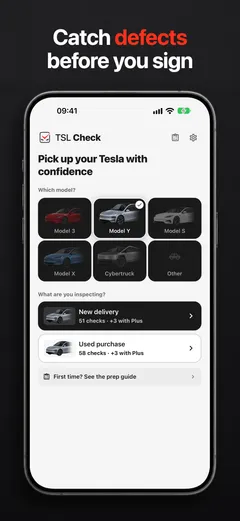
TSL Check is the iPhone app we make for that moment. You choose your model at the start, and the delivery checklist walks you through the car area by area, with the severity of each item and a place for a photo and a note (how it works). Write the equipment from your order next to it and compare. If the wait is long, see why the delivery date changes.
See also, if you are comparing across brands: BYD Seal vs Tesla Model 3 (UK figures), BYD Seal U DM-i vs Tesla Model Y (UK figures, plug-in hybrid against electric) and Model Y vs Rivian R2 (US figures). For the top of the range, see Model Y Performance vs Premium.
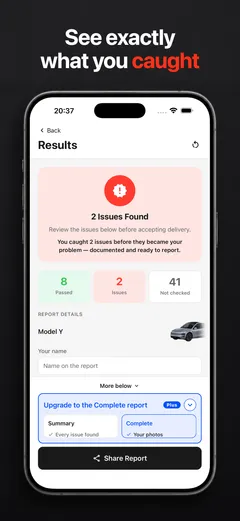
Whatever you find, ask the delivery advisor to record it before you sign. What you can do next depends on your contract and local consumer law, so read your order paperwork before the day.
Frequently asked questions
Is the Model Y Standard a different car from the Premium?
Both are Model Y. On Tesla's Compare Models page they share the body, five seats, 16-inch front touchscreen, 76 cubic feet of cargo space and towing capacity. The Standard has fewer comfort and finish items and different performance figures, which the tables in this guide list row by row.
How much range do you give up with the Standard?
Tesla's Compare Models page lists an EPA estimated range of 321 miles for the Standard rear-wheel drive and 355 miles for the Premium rear-wheel drive. By our arithmetic that is 34 miles. The Standard all-wheel drive is listed at 294 miles. Range varies with wheels, conditions and how you drive.
Does the Standard charge slower?
Tesla does not list a peak charging rate in kilowatts on that page. It lists how much range you add in 15 minutes of Supercharging: up to 160 miles for the Standard rear-wheel drive, 152 for the Standard all-wheel drive and 182 for the Premium rear-wheel drive.
Does the Standard have a glass roof or ventilated seats?
No on both counts, according to Tesla's page. The Standard lists a knit textile roof and heated, power-reclining front seats; the Premium lists a panoramic glass roof and front seats that are heated and ventilated.
Can I confirm at delivery that the car has what I ordered?
Yes. Keep your order summary and compare it with the car in front of you, item by item. If something listed on your order is missing, ask the delivery advisor to record it before you sign.
Are the figures the same in Europe or Canada?
Not necessarily. This guide covers the United States. Tesla's page for your country can list different equipment, ranges and charging figures for the same version names.