What should I ask a private seller before I view a used Tesla?
Ask for the VIN, the service and accident history, how the car was charged and what warranty coverage is left, then check each answer against official records before you travel. A seller who will not share the VIN, or who refuses an independent inspection, is a good reason to walk away.
Who this guide is for
This guide covers the United States and sales between private individuals, not dealers. Rules for dealers and for other countries differ. The questions below work for any used Tesla; the sources behind them are listed at the end.
Why the questions matter more with a private seller
The Federal Trade Commission explains the catch: private sellers generally are not covered by the Used Car Rule, and private sales usually are not covered by the implied warranties of state law. A private sale “probably will be on an ‘as is’ basis,” unless your purchase agreement states otherwise. Once you have paid, there is little to fall back on, so the work happens before you pay: ask, check, inspect.
Ask for the VIN first
Ask for the VIN before you drive anywhere. Every check below starts from it: the FTC says you can investigate a car’s history by its VIN, and an inspection report should list the make, model and VIN. If the seller will not share it, stop there.
Questions about the car’s history
- How many owners has it had, and who owns it now?
- Has it had an accident, a repair or a repaint? Was it ever flooded or declared salvage?
- Can you send the maintenance and service records?
- Which shop did most of the work?
The FTC tells buyers to ask for the maintenance record from the owner, dealer or repair shop. The Department of Justice adds that if the owner lacks copies, you can “contact the dealership or repair shop where most of the work was done,” and that you should talk to the previous owner if the current one does not know the car’s history.
Questions about how it was used
- Why are you selling?
- Was it ever a rental, fleet or company car?
- Where has it lived: city streets, long highway commutes, salt and snow, or a warm garage?
None of these has a right answer. They tell you what kind of wear to look for when you see the car, and they let you compare the story with the records.
Questions about charging and the battery
- How was it usually charged: mostly at home, or often at fast chargers?
- Has the battery or any high-voltage part ever been repaired or replaced?
- Can you charge it to 100% before I come and tell me the range the car shows?
These are questions, not tests. The answers give you something to compare with what you see on the day, and with the rated range for that model year and trim. If you plan to charge it at home, our guide on charging a Tesla from a normal outlet covers what Tesla says about speed and daily miles.
Questions about warranty and recalls
- What warranty coverage is left, and can you show me the paperwork?
- Will you do the ownership transfer through Tesla?
- Does the VIN have any open recalls?
Tesla’s Vehicle Warranty page answers the transfer question directly: the New Vehicle Limited Warranty “will follow your vehicle and be transferred to the new owner when a vehicle ownership transfer is performed through Tesla.” The condition matters, so ask for the transfer to go through Tesla. For anything else, the FTC warns that warranties and service contracts may not be transferable and tells buyers to review them before buying. It says to verify what is covered, the expiration date or miles and the paperwork with the manufacturer, and to have the VIN ready when you call. For recalls, the FTC points to the National Highway Traffic Safety Administration’s lookup by VIN, which lists unrepaired recalls, and notes that federal law does not require dealers to fix recalls on used cars, so you might need to get the repair done yourself.
Questions about the paperwork
- Is the title in your name, and is any loan still owed on the car?
- Will you put the price, the VIN and any promises in a written contract?
Paperwork rules differ by state, so ask your state’s motor vehicle agency what you need. On the contract, the FTC is clear that if you have one, the seller must live up to the promises stated in it.
A message you can send
Short and specific gets replies. Something like this, adapted to the car:
Hi, I’m interested in your Model Y. Before I travel to see it, could you send the VIN, the service records and any accident or repair history? Is there warranty coverage left, and is the title in your name? I’d also like to have an independent mechanic look at it. Thanks.
A seller with nothing to hide usually answers all of it, and how they answer tells you as much as what they say.
Check the answers before you travel
A seller’s word is the start, not the end. The FTC points to a trusted database service that gathers information from state and local authorities, salvage yards and insurance companies. The Department of Justice’s NMVTIS offers information about a vehicle’s title, odometer data and certain damage history, and the National Insurance Crime Bureau keeps a free database that includes flood damage. If a report is not recent or looks incomplete, the FTC says to verify it with the reporting company.
Red flags, in our reading
These are our judgment, not an official list. Think twice if the seller will not share the VIN, will not allow an independent inspection, asks you to pay or put down a deposit before you have seen the car, or gives answers that change between messages. Any one of them can have an innocent explanation, but each one costs you nothing to walk away from.
What phone and email cannot settle
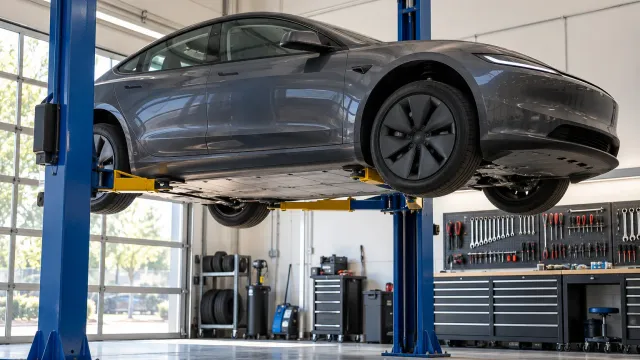
Everything above happens before you see the car. Some things only show in person: the battery’s real range, the 12V battery, brakes and rust, panel gaps and repaint, the screen, and whether the paperwork matches the car in front of you. The FTC says it is best to have any used car inspected by an independent mechanic before you buy, to ask the mechanic for a written report with a cost estimate, and to use the estimate to negotiate.
After the sale, our guide on what to check in the first week with a used Tesla covers the Tesla account, the keys and the first routine.
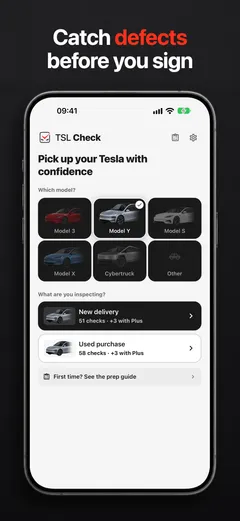
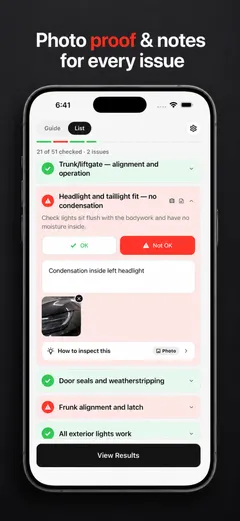
For the part you do yourself, TSL Check is the iPhone app we make. Its used-car checklist covers battery and range, the 12V battery, brakes and rust, title and liens, service and accident history, mileage and warranty, and it keeps your photos and notes on each item so you can send them to the seller or to your mechanic (how it works). It does not replace the mechanic.
Frequently asked questions
What does "as is" mean when I buy from a private seller?
The FTC says private sales usually are not covered by the implied warranties of state law, so a private sale probably will be on an "as is" basis unless your purchase agreement with the seller states otherwise. If you have a written contract, the seller must live up to the promises stated in it.
Should I get a vehicle history report?
Yes. The FTC's guide tells buyers to get an independent review of a vehicle's history. The Department of Justice's NMVTIS offers information about a vehicle's title, odometer data and certain damage history. A report is no substitute for an inspection by an independent mechanic.
Is there a free way to check for flood damage?
The FTC says the National Insurance Crime Bureau maintains a free database that includes flood damage and other information, and that you can look up a car's history by its VIN.
How do I check a used Tesla for open recalls?
The FTC says you can enter the VIN in the recall lookup run by the National Highway Traffic Safety Administration, or call its Vehicle Safety Hotline. It also notes that federal law does not require dealers to fix recalls on used cars, so you might need to get the repair done yourself.
Does the Tesla warranty come with the car?
Tesla's warranty page says the New Vehicle Limited Warranty will follow your vehicle and be transferred to the new owner when a vehicle ownership transfer is performed through Tesla. So ask the seller to do the transfer through Tesla. The FTC adds that other warranties and service contracts may not be transferable, so ask to review any of those before you buy.
Do I still need a mechanic if I use a checklist app?
Yes. The FTC says it is best to have any used car inspected by an independent mechanic before you buy it. A checklist helps you notice and document what you see; it does not replace a mechanic.
Sources
- Tesla Support: Vehicle Warranty (United States), consulted Oct 19, 2026 (opens in a new tab)
- Federal Trade Commission: Buying a Used Car (consumer guide, April 2021), consulted Oct 19, 2026 (opens in a new tab)
- U.S. Department of Justice, NMVTIS: Used Car Buying Tips, consulted Oct 19, 2026 (opens in a new tab)